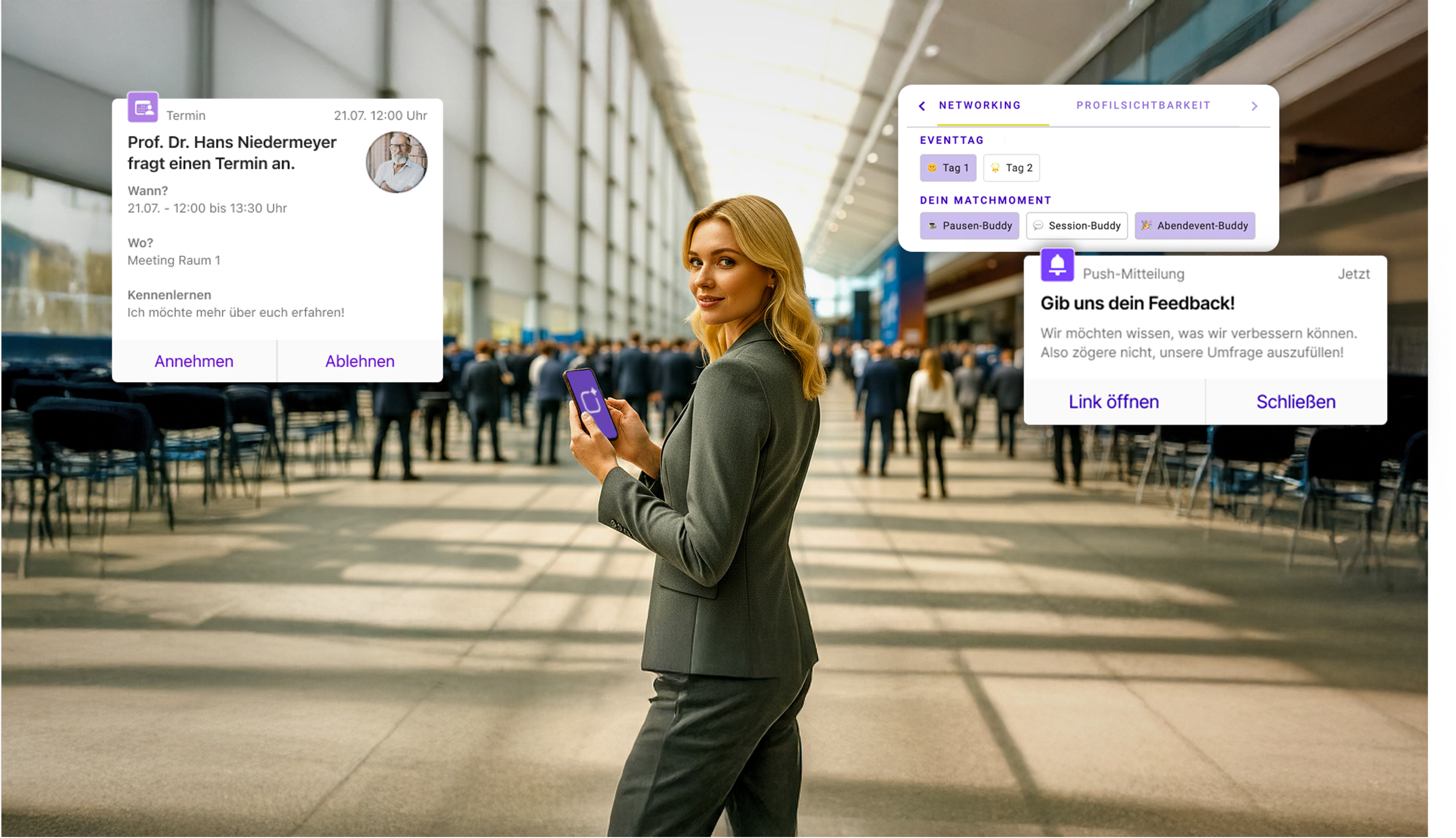

Digital events have changed fundamentally in recent years. Events are no longer limited to a single day or location, but are part of ongoing communication. Today, companies expect solutions that not only inform, but also connect people, provide content and build communities on a long-term basis.
This is precisely where the Mobile Event App is increasingly reaching its limits. It is usually focused on individual events and offers little flexibility for long-term usage scenarios. Demand is therefore shifting more and more from pure event apps to holistic event platforms.
Against this backdrop, the switch from the mobile event app to Polario is not merely a product update, but a strategic development.
From the mobile event app to the Polario event platform
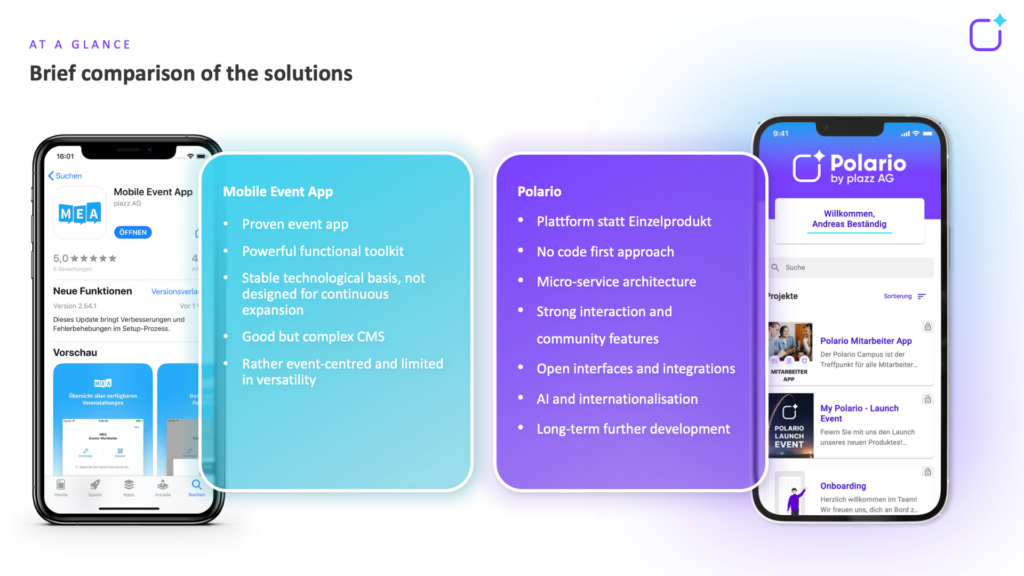
Over the years, the Mobile Event App has established itself as a reliable solution for event organisation, agenda display and participant communication. It fulfils many classic requirements very well, but is technically and conceptually designed for individual events.
The Polario Event App takes a different approach. Instead of mapping isolated events, Polario sees itself as a central event platform that connects events, content and communities. This transforms a temporary solution into a permanently usable digital environment.
This change in perspective is crucial. Events are no longer seen as one-off touchpoints, but as part of an ongoing relationship between companies and target groups.

The Polario approach
Today’s event platforms need to be capable of much more than traditional event apps. They must be flexibly expandable, support different formats and integrate seamlessly into existing system landscapes.
Polario was developed precisely to meet these requirements. The platform is based on a modern, modular architecture that enables continuous further development. New functions can be added without compromising existing structures. This creates a solution that grows with the requirements of the company.
At the same time, the no-code approach allows for significantly faster and more independent content maintenance. Specialist departments can create and update pages, content and media themselves without relying on technical support. This reduces complexity and noticeably speeds up processes.
The central CMS as the key to rapid implementation
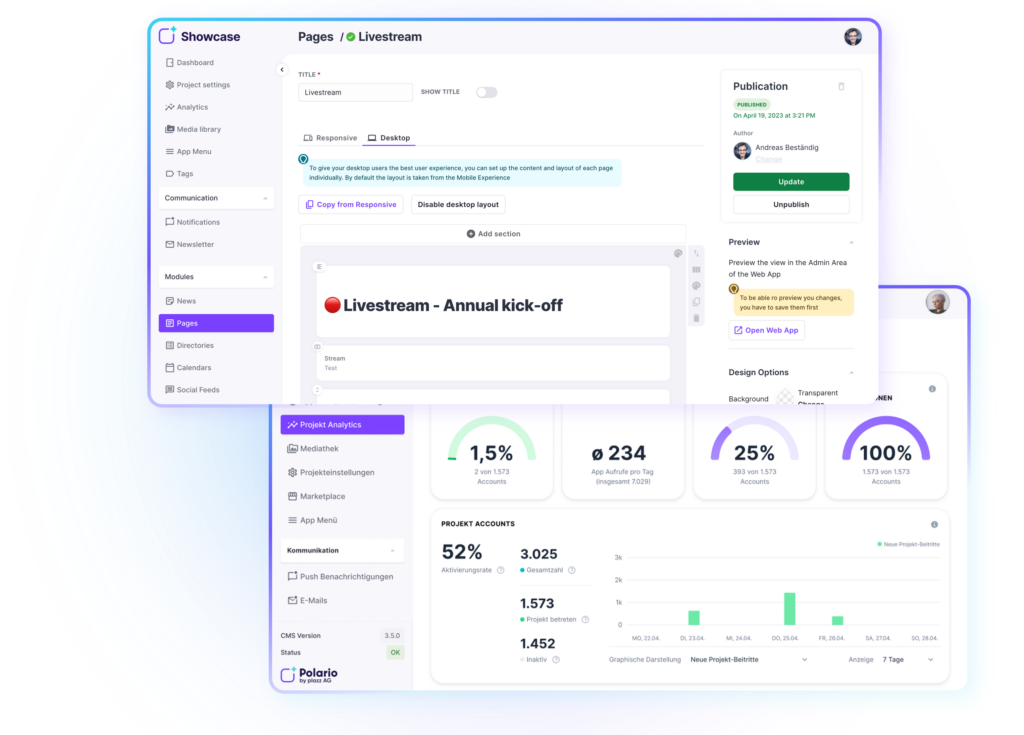
A key difference between the Mobile Event App and Polario lies in how they handle content. While traditional event apps often come with a complex and technically oriented CMS, Polario consistently relies on a central no-code CMS that is designed for ease of use right from the start.
Content can be created and structured using drag-and-drop, without the need for technical knowledge. Pages, content and modules can be flexibly structured and adapted at any time. This significantly reduces the learning curve and allows new content to be implemented much faster than in classic event app structures.
The integrated page builder offers a high degree of creative freedom. Layouts can be customised without being limited to rigid templates. This is complemented by a variety of widgets that allow documents, calendar entries, directories or external content to be integrated directly into the event platform via iFrames.
Another advantage is that Polario actively supports users in their work. Tutorials are integrated directly into the respective features, so that new functions can be understood and used without external training. This makes the CMS not only powerful, but also sustainable – even for teams without technical expertise.
Polario as a communication and community solution
A key difference between the Mobile Event App and Polario lies in their understanding of communication. While the Mobile Event App was primarily limited to the duration of the event, Polario accompanies users before, during and after the event.
Integrated social feeds, channels and target group-specific content create a lively communication environment. Participants exchange ideas, content remains available and events have a long-term impact. Polario thus becomes more than just a short-term tool.
This approach opens up completely new possibilities, especially for companies with regular event needs or internal communication formats.
Polario as an interactive powerhouse for events
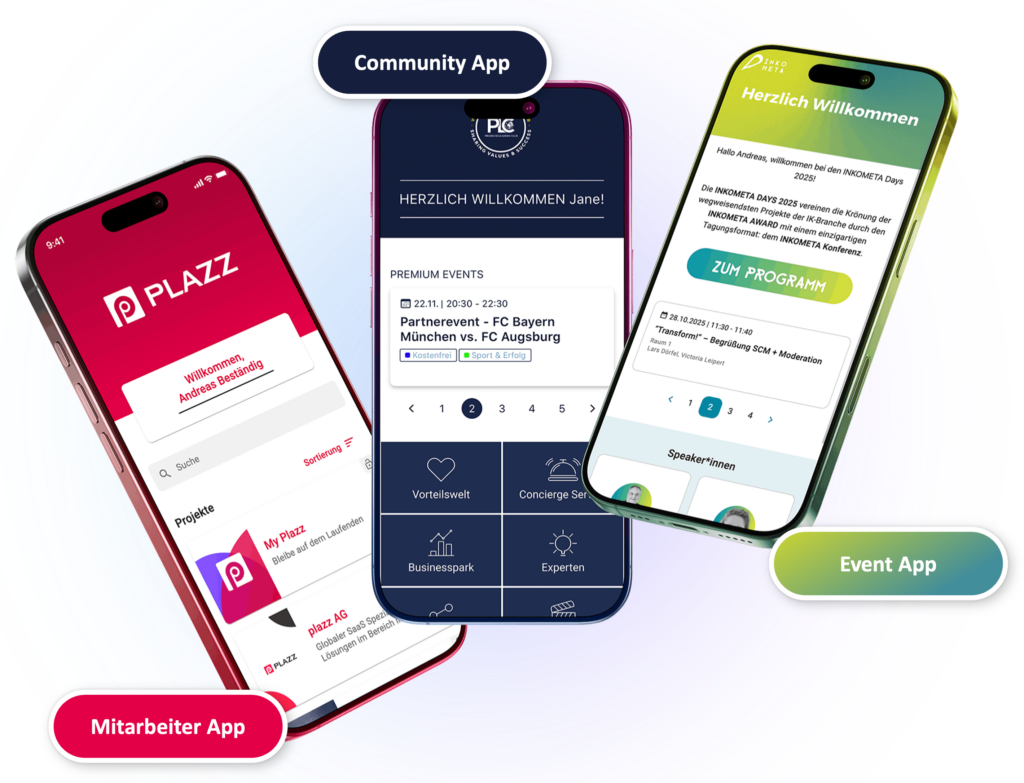
Polario is designed to not only map digital event formats, but also actively support and accelerate them. A key advantage is rapid deployment: automated build pipelines allow an app to be deployed in a very short time, meaning that new event formats or customisations can go live much faster than with traditional event app setups.
At the same time, Polario noticeably expands the scope of interaction and communication. Traditional chats and news are supplemented by social feeds, channels and group chats, so that communication takes place not only during the event, but before, during and after it. In addition, content and communication can be tailored to specific target groups, providing participants with more relevant information and making the platform more effective overall.
Livestreams and media formats are also not intended as add-ons in Polario, but as an integral part of the platform. Livestreams, videos, podcasts and virtual sessions are directly integrated and thus designed from the outset for the implementation of hybrid and virtual formats. This transforms a classic event app into a platform that permanently connects events and communication and seamlessly links media content with the event experience.
 Openness and integration as a long-term advantage
A key difference between Polario and traditional event apps is its open platform approach. The event platform is based on an open API and follows a headless approach, which clearly separates content, functions and front ends. This architecture makes it much easier to connect external systems and creates a high degree of technical flexibility.
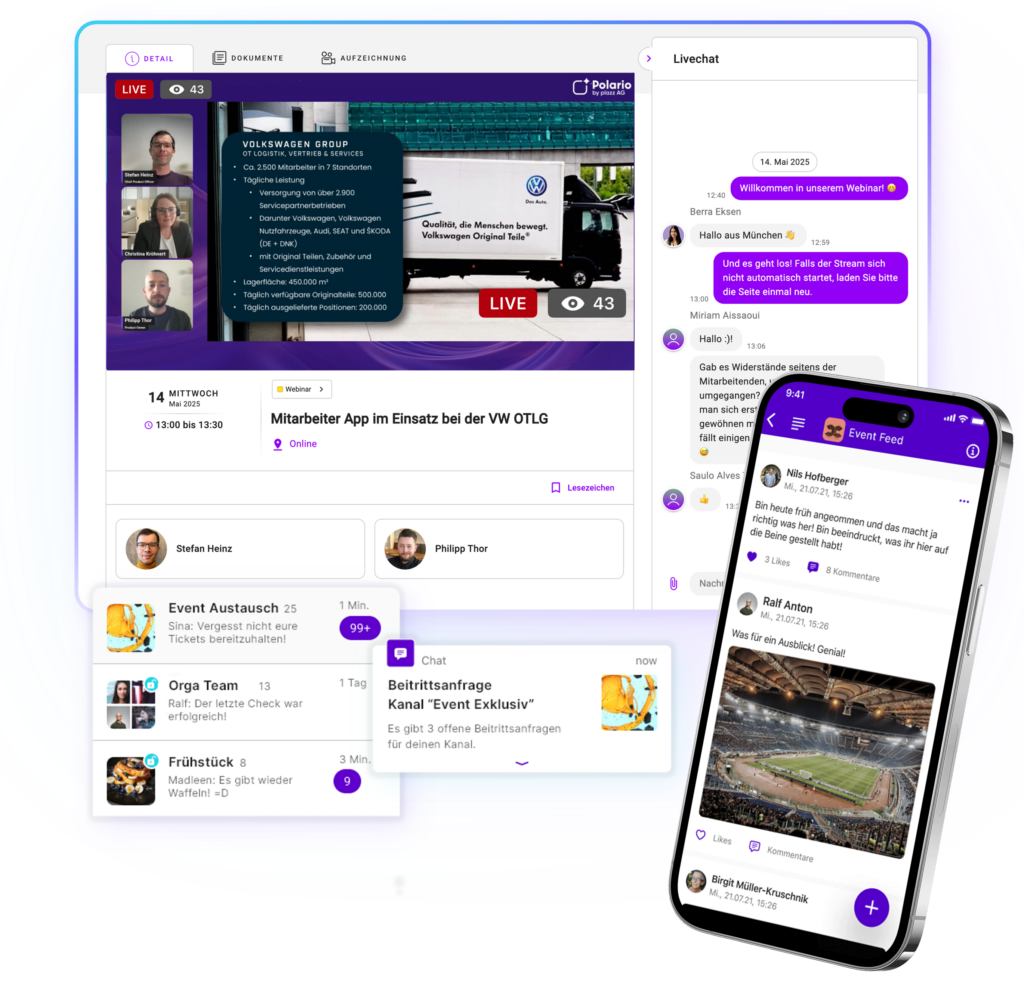
Existing tools, such as those used for ticketing, CRM or marketing, can be integrated in a structured manner and expanded in a targeted manner via the RESTful API. Compared to mobile event apps, this makes the integration of external systems much easier and more sustainable.
The open and headless approach ensures that Polario remains flexible in the long term and avoids technological dependencies. At the same time, customer-specific requirements can be implemented without restricting the platform for other users. This architecture forms the basis for a permanently scalable event platform that can be continuously developed.
Artificial intelligence as part of the event platform strategy
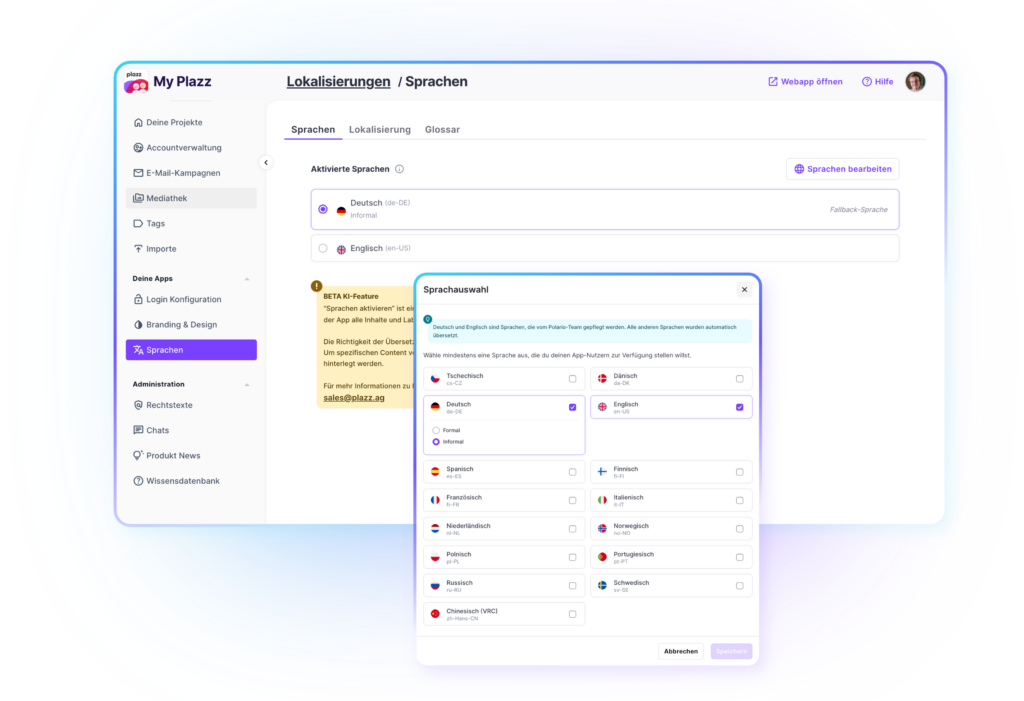
Polario does not view artificial intelligence as an isolated feature, but rather as an integral part of its platform strategy. AI-supported translations are already in use today, facilitating multilingual use.
In addition, the platform creates the basis for further AI applications, for example in the area of personalised content or intelligent networking of participants. This means that Polario not only remains technologically up to date, but also open to future developments.
Secure product changeover without loss of functionality
A common obstacle when switching from the Mobile Event App to Polario is concern about risks. Polario addresses this challenge with a clear migration concept. Existing use cases for the Mobile Event App can be fully mapped and are functionally enhanced.
At the same time, all relevant security and data protection standards are maintained. Hosting and development take place in the United Kingdom, and compliance with the GDPR and established security certifications is an integral part of the platform.
The switch to Polario therefore does not mean a break, but rather a controlled further development.
White paper available for free download
An accompanying white paper on switching from the Mobile Event App to Polario is also available for free download. It highlights the platform strategy, technical fundamentals and decision-making aspects surrounding the use of a modern event platform.
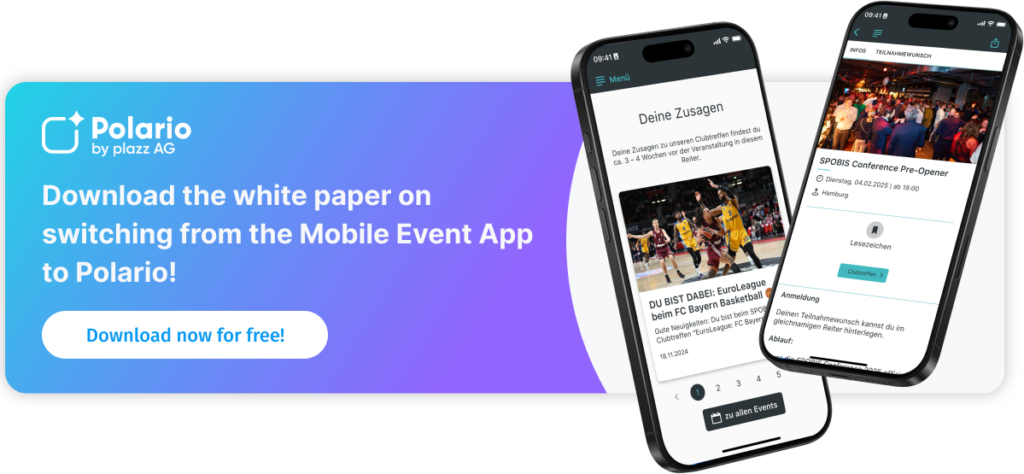
Download the white paper now for free: https://mobile-event-app.com/en/prasentation-mea-zu-polario/
Conclusion
The requirements for digital events have changed, and with them the requirements for the solutions used. For many companies, the mobile event app is no longer sufficient when events, communication and community are considered holistically and in the long term.
The switch from the mobile event app to Polario shows how these requirements can be bundled in a modern event platform. Polario combines events, content and interaction in a centralised solution, creating a sustainable basis for digital event formats and communities.
For companies that want to further develop their event strategy, the move from the mobile event app to Polario is a logical and sustainable decision.